
Understanding 'Feels-Like' Temperature on Smart Displays
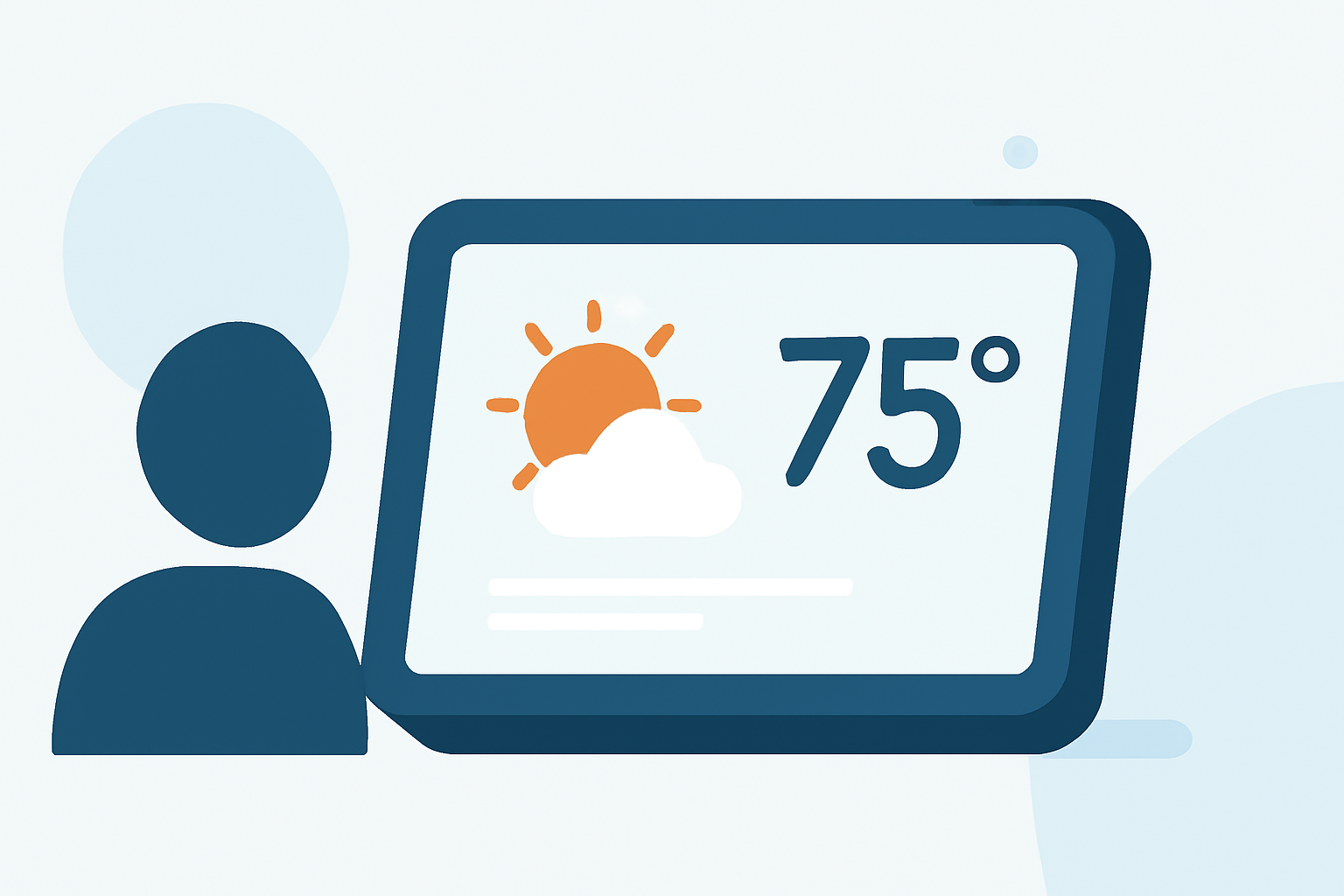
When checking the weather on your smart display, you might notice a "feels-like" temperature alongside the actual air temperature. This metric provides a more accurate representation of how the weather conditions will feel to your body, considering factors like humidity and wind speed.
What Is 'Feels-Like' Temperature?
The "feels-like" temperature, also known as the apparent temperature, combines the actual air temperature with environmental factors to estimate how the weather feels to the human body. This calculation accounts for:
- Humidity: In high humidity, sweat doesn't evaporate efficiently, making it feel hotter.
- Wind Speed: Wind can accelerate heat loss from the body, making it feel colder.
For instance, on a 90°F day with high humidity, the "feels-like" temperature might be 100°F, indicating a more oppressive heat. (popsci.com)
How Is It Calculated?
The calculation of the "feels-like" temperature varies based on the season:
- In Cold Weather: The wind chill index is used. It combines air temperature and wind speed to determine the equivalent temperature in calm conditions. A commonly used formula is:
Wind Chill (°F) = 35.74 + 0.6215T - 35.75(V^0.16) + 0.4275T(V^0.16)
Where T is the temperature in °F and V is wind speed in miles per hour. (climate.umt.edu)
- In Warm Weather: The heat index is applied. It combines air temperature and relative humidity to estimate the apparent temperature. A widely used formula is:
HI = -42.379 + 2.04901523*T + 10.14333127*RH - 0.22475541*T*RH - 0.00683783*T*T - 0.05481717*RH*RH + 0.00122874*T*T*RH + 0.00085282*T*RH*RH - 0.00000199*T*T*RH*RH
Where T is the temperature in °F and RH is the relative humidity expressed as a percentage. (climate.umt.edu)
Why Is It Important?
Understanding the "feels-like" temperature helps you prepare for the actual conditions you'll experience. For example, if the "feels-like" temperature is significantly higher than the actual temperature, it's advisable to stay hydrated and wear light clothing. Conversely, if it's lower, dressing in layers and protecting exposed skin becomes crucial.
How Do Smart Displays Show This Information?
Smart displays integrate weather data to provide real-time updates, including the "feels-like" temperature. They gather information from various sources, such as local weather stations and online databases, to calculate and display this metric. By presenting both the actual and "feels-like" temperatures, these devices offer a comprehensive view of the current weather conditions, aiding in better daily planning.
Conclusion
The "feels-like" temperature is a valuable metric that enhances your understanding of current weather conditions. By considering factors like humidity and wind speed, it provides a more accurate representation of how the weather will feel to your body, allowing for better preparation and comfort.