
How Storm-Tracking Radar Helps Protect Communities
Last updated: 2026-03-18
For most people in the U.S., the most practical way storm-tracking radar protects your community is by pairing live radar maps with timely alerts in an app like Clime, so you see dangerous storms coming and get warned in time to act. If you run higher‑risk facilities or public safety operations, you may layer on more specialized services, but everyday residents mainly need clear radar views and reliable alerts in their pocket.
Summary
- Storm-tracking radar detects where rain, hail, and rotation are, turning invisible hazards into visible, trackable threats.
- Dual‑polarization radar reveals precipitation type and even tornado debris, sharpening warnings and cutting false alarms. (National Weather Service)
- Fusing radar with satellites and models extends lead time, so officials can plan evacuations and people can secure homes and businesses. (NOAA NESDIS)
- Clime packages this ecosystem into an easy radar‑first app with severe weather, rain, hurricane, lightning, and wildfire layers that fit how most communities actually prepare. (Clime)
What exactly does storm-tracking radar do for a community?
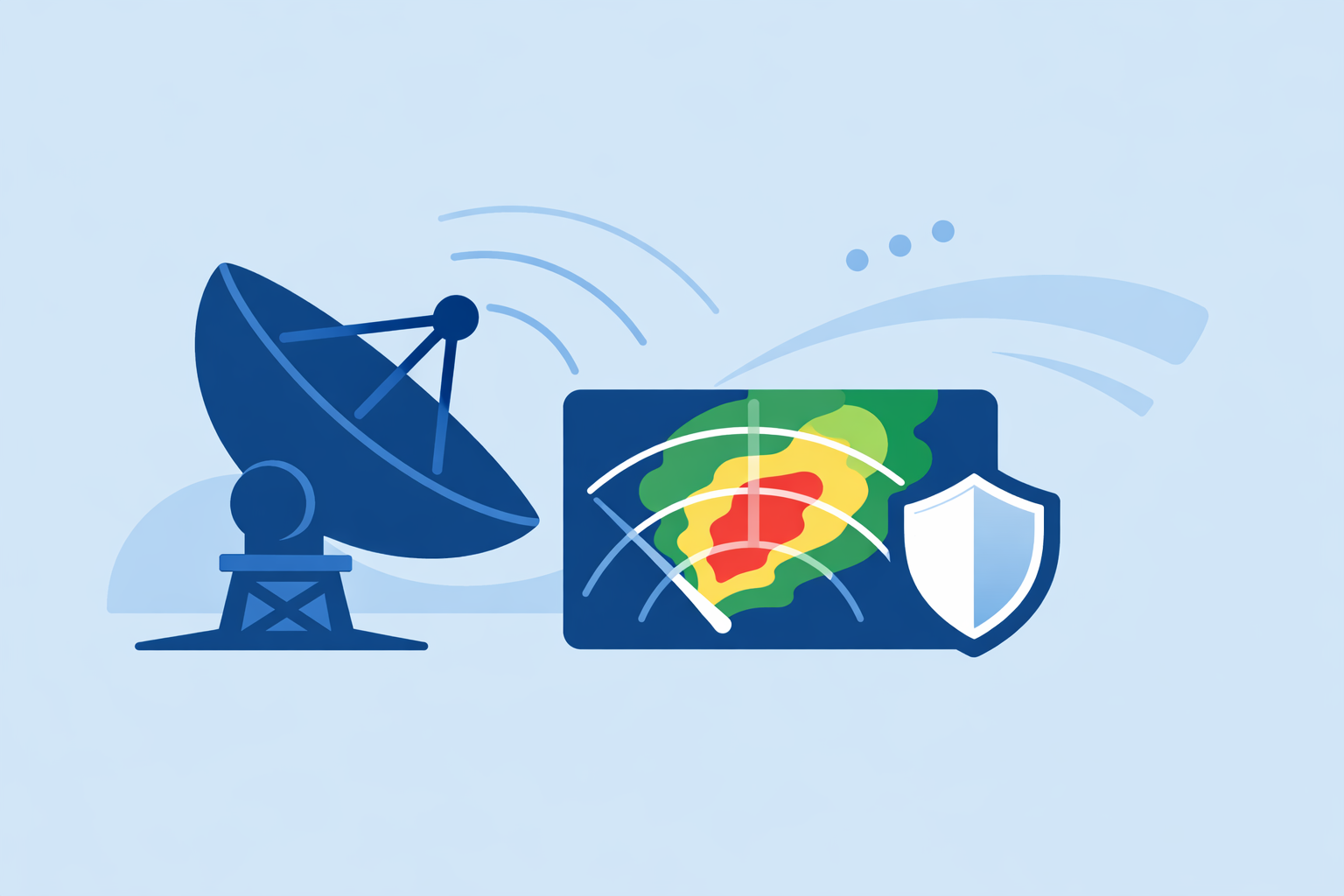
Storm-tracking radar is the backbone of severe weather awareness in the United States. Doppler weather radars sweep the atmosphere, bouncing energy off raindrops, hail, and other objects to show where storms are, how intense they are, and how they are moving.
That picture matters because it turns vague forecasts into specific, local risk. Instead of just hearing “storms this evening,” you can see a defined line of thunderstorms 40 miles to your west, moving toward your town. Emergency managers can judge when to open shelters, school leaders can decide whether to dismiss early, and families can choose when to get off the road.
On phones, storm-tracking radar shows up as animated maps—what you see in Clime, The Weather Channel, AccuWeather, and similar products all starts from the same national network of Doppler radars operated by NOAA and the National Weather Service.
How does dual‑polarization radar sharpen warnings?
Traditional Doppler radar measures energy in a single orientation. Dual‑polarization (dual‑pol) radar sends and receives pulses in both horizontal and vertical orientations, which lets meteorologists infer the shape and consistency of what the radar beam is hitting.
The National Weather Service notes that dual‑pol helps forecasters clearly distinguish between rain, hail, snow, and ice pellets, significantly improving forecasts and warnings for different types of storms. (NWS) This means:
- Better hail and flooding calls – Knowing where the heaviest, most water‑loaded cores are helps identify flash‑flood and severe hail threats.
- Less confusion from clutter – Dual‑pol can more easily separate birds or ground clutter from real precipitation.
- Tornado debris detection – When a tornado lofts building materials and trees into the air, dual‑pol can detect a distinct debris signature. NWS training materials explain that when this appears, warnings can be upgraded to a "radar confirmed tornado," even at night. (NWS SkyWarn training)
For communities, this pushes warnings beyond “possible tornado” toward “confirmed, destructive tornado,” which changes how people respond. Sirens, text alerts, and push notifications carry more weight when local officials know a tornado is actually on the ground.
In consumer apps, you don’t directly toggle dual‑pol products, but you benefit from them. The radar imagery and warning polygons that Clime and other tools show are shaped by NWS forecasters who rely on dual‑pol data under the hood. (NWS)
How does storm radar translate into real-world protection and fewer casualties?
Radar’s impact is measurable. NOAA has documented that the installation of Doppler radar across the U.S. helped reduce tornado fatalities by roughly 45% and injuries by about 40%, largely by improving warning lead times and accuracy. (NOAA)
In practice, radar helps in three ways:
- Lead time – Seeing rotation or a rapidly intensifying storm on radar gives forecasters minutes to issue a warning before damage starts. Those minutes are what let schools move students to hallways and families to basements.
- Targeted warnings – Instead of issuing county‑wide alerts, radar allows warnings to be drawn as polygons following the storm path, so the right neighborhoods take action while others aren’t repeatedly over‑alerted.
- Continuous updates – With updates every few minutes, officials can track whether a storm is strengthening, weakening, or splitting and adjust public messaging.
Apps like Clime sit on top of that system and deliver it to individuals. Our radar‑centric map based on NOAA data is designed so you can quickly see the storm’s structure and projected path at a neighborhood scale, and then layer on severe weather and rain alerts to translate that picture into “act now” moments on your phone. (Clime)
How do satellite data and models extend protection beyond the radar range?
Radar is strongest within a few hundred miles of each site and mainly sees what’s happening now. Satellites and numerical models fill in what’s coming next.
NOAA explains that combining satellite observations with models can increase severe‑weather forecast accuracy three to seven days ahead of time, which gives decision‑makers room to plan evacuations, pre‑position resources, and brief the public. (NOAA NESDIS) For coastal and river communities, that early window is what determines whether a town can organize orderly evacuations instead of last‑minute chaos.
Real‑time Doppler radar and airborne radar data also feed hurricane models, improving track and intensity forecasts that guide evacuation zones and timing. (NOAA AOML)
Clime doesn’t try to turn you into a forecaster; instead, we surface the parts that matter for day‑to‑day life:
- A live radar map for what’s happening now
- Hourly and 10‑day forecasts for planning
- A hurricane tracker that visualizes large‑scale storm paths on the same map you use every day (Clime)
For most households, that combination—near‑term radar plus short‑ and medium‑range forecast context—is enough to decide when to cancel a game, sandbag a doorway, or get out of town.
How do local spotters and alerts complement radar?
Even with sophisticated radar, human eyes on the ground still matter. The National Weather Service points out that spotter reports, combined with radar analysis, help local officials decide when to sound sirens and activate community safety plans. (NWS Norman)
In a U.S. town, the loop often looks like this:
- Radar suggests a storm is rotating or producing extreme rain.
- Spotters confirm hail size, funnel clouds, flooding, or damage.
- Forecasters update warnings.
- Local agencies trigger sirens, reverse‑911 systems, and app alerts.
Your role is to receive and act on those alerts quickly. Clime’s severe weather alerts for saved locations and rain alerts are built for that last mile—turning expert analysis and spotter reports into a vibration and notification on your phone that says, effectively, “this is for you, right now.” (Clime App Store)
Where do everyday apps like Clime fit next to more specialized tools?
There are many public and commercial tools built on the same radar backbone. AccuWeather leans into hyperlocal timing via MinuteCast and offers enterprise services like SkyGuard for businesses that need bespoke warning protocols. The Weather Channel markets Premium Radar layers and a Storm Radar app focused on deeper overlays, especially for enthusiasts. (AccuWeather) (Weather.com)
By contrast, Windy.app focuses on wind and marine conditions for sports and is still evolving its live radar, which makes it more of a complement than a primary storm safety app for most households. (Windy.app)
At Clime, we focus on what typical residents, commuters, and small businesses actually need in the U.S.:
- A radar‑first map centered on your locations, based on NOAA data, that makes storm structure and motion obvious at a glance. (Clime)
- Integrated layers for lightning, hurricanes, and wildfires so you don’t have to juggle multiple niche apps for different hazards. (Clime)
- Clear, automatic alerts mapped to the same view you already trust.
If you manage a refinery, stadium, or logistics hub, it can be reasonable to add specialized enterprise services on top of this foundation. For most people, though, the practical protection comes from understanding the map, trusting the alerts, and checking it often enough to stay ahead of changing storms—which is exactly the workflow Clime is built around.
How much does the technology still need to improve?
Research groups are already testing next‑generation phased array radar that can scan storms much faster than today’s NEXRAD sites, with the goal of giving forecasters more frequent updates and potentially longer lead times for tornado and severe‑storm warnings. (NSSL) Machine‑learning algorithms applied to radar data, such as systems that estimate tornado probability from storm structure, are also being explored to assist meteorologists in real time. (NSSL)
The important point for communities is that protection keeps improving, but the basics remain the same: understand the risk, watch the radar, and act on trusted warnings. Consumer apps don’t need every experimental radar product to be useful—they need to make the core signals from NWS and NOAA immediately understandable and actionable.
That is where simple, radar‑forward tools like Clime have an advantage for everyday users. We lean on the national radar and satellite infrastructure, plus ongoing research, and then concentrate that complexity into one map and one alerting system that most people can read in seconds.
What we recommend
- Use a radar‑centric app like Clime as your default window into storm risk, and check it when forecasts hint at severe weather.
- Turn on severe weather, rain, lightning, hurricane, and wildfire layers and alerts for both home and key locations like schools or elderly relatives.
- When warnings are issued, cross‑check the polygon on the radar map so you know if your neighborhood is in the path.
- If you are responsible for high‑risk facilities, layer specialized services or additional platforms on top of this foundation—but keep a simple, everyday view like Clime as your shared reference with staff, family, and neighbors.