
Storm Tracking Radar Data Update Frequency: How Often Your Map Really Refreshes
Last updated: 2026-03-14
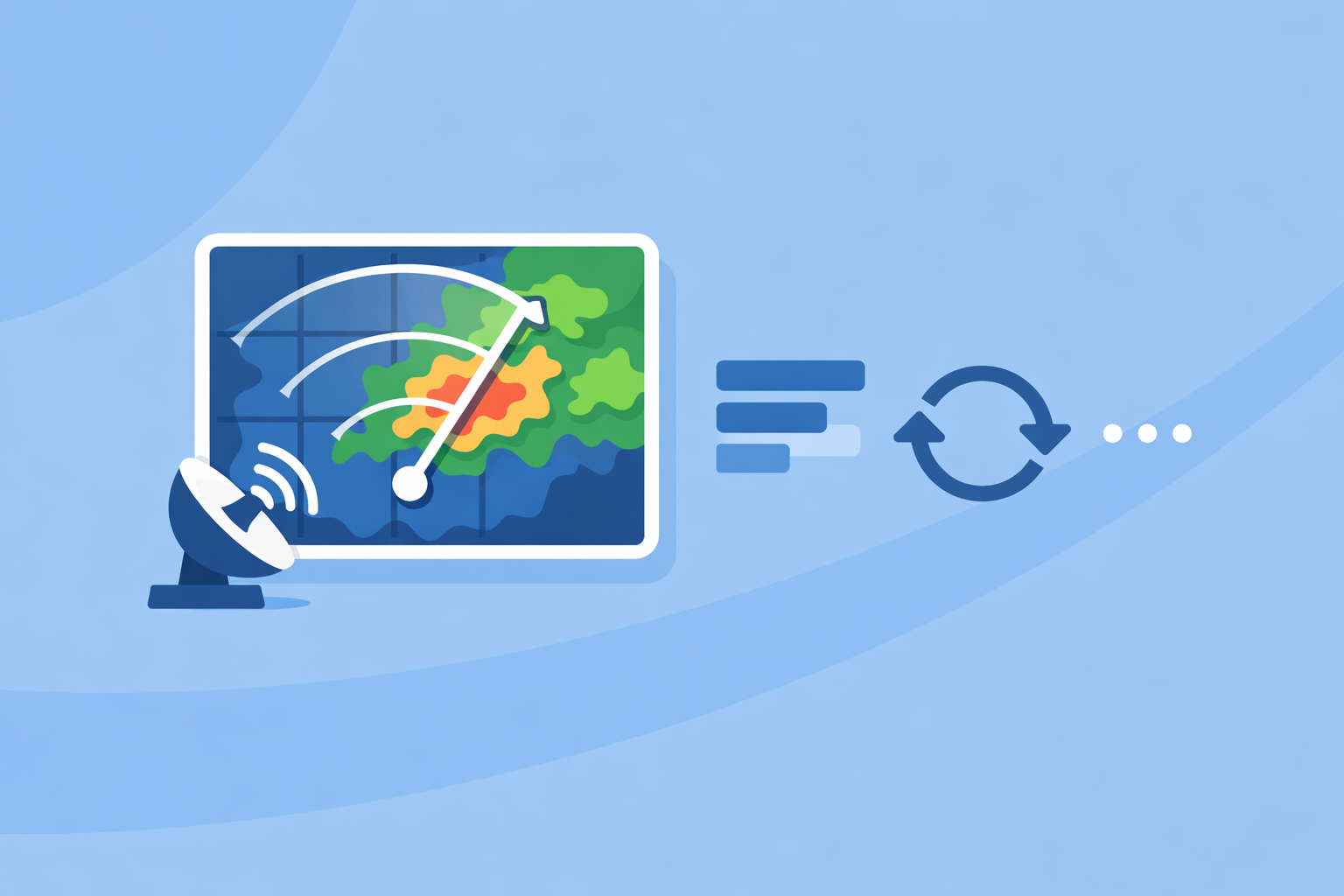
For most people tracking storms in the U.S., radar data on apps like Clime effectively refreshes about every 5–10 minutes, with faster low‑level updates during active weather. If you work in a safety‑critical role and need sub‑minute scans, that’s still the domain of specialized tools and emerging phased‑array systems, not everyday consumer apps.
Summary
- U.S. NEXRAD Doppler radars typically complete a full volume scan every 4–6 minutes in storm mode, and roughly every 10 minutes in quiet conditions. (NOAA NSSL)
- Special scan strategies (SAILS/MESO‑SAILS/AVSET) can push fresh low‑level storm slices as quickly as about every 72 seconds. (RadarScope)
- Consumer apps, including Clime, sit on top of those government feeds; practical refresh feels like 5–10 minutes plus a bit of app processing and internet lag.
- For most U.S. households, a NOAA‑based radar app like Clime offers a strong mix of frequent radar updates, lightning and hurricane layers, and simple visuals without the complexity of pro‑grade tools.
How often does U.S. storm‑tracking radar actually update?
When you ask, "How often does radar update?" you’re really asking about the National Weather Service’s NEXRAD (WSR‑88D) network. That’s the backbone most U.S. storm‑tracking apps rely on.
In active precipitation mode, a NEXRAD radar typically needs about 4–6 minutes to complete a full 3D volume scan of the atmosphere. (NOAA NSSL) In quieter, clear‑air conditions, the system slows down and a volume scan is closer to 10 minutes. (RadarScope)
That means, in normal storm situations, the base data your app can pull from is at best a few minutes old by the time you see it. No app is truly "real time" in the literal, second‑by‑second sense.
Clime uses NOAA‑sourced radar mosaics as the default radar layer, so the heartbeat of what you see in the U.S. follows this same 4–10 minute NEXRAD rhythm. (climeradar.com)
How do SAILS and MESO‑SAILS make low‑level storm scans faster?
If a tornado‑warned supercell is bearing down on a town, waiting 5 or 6 minutes between low‑level scans is a long time. To close that gap, the NEXRAD network uses special strategies like SAILS, MESO‑SAILS, and AVSET.
These modes insert extra low‑level sweeps into the middle of a broader volume scan. In practice, that can deliver fresh near‑surface data as quickly as every ~72 seconds in some cases. (RadarScope)
That doesn’t change the full‑volume timing much, but it does mean:
- The lowest tilt—where you tend to watch for hook echoes and heavy cores—can refresh faster than the rest of the scan.
- During intense weather, the images you see of storm bases and heavy rain bands may be only a minute or two old instead of five or more.
Consumer apps like Clime don’t expose knobs for SAILS or MESO‑SAILS the way specialist tools do, but they benefit from the faster slices automatically because the upstream NOAA feed is updating more often during those high‑impact events.
How much lag do apps add on top of radar update frequency?
Even if a radar is scanning every few minutes, your phone still has to get that data. There are three main steps where a little extra delay creeps in:
-
Data ingestion and mosaicking Radar sites send their scans to central servers, where they’re stitched into regional and national mosaics. That tiling and quality‑control step adds a bit of processing time.
-
App polling behavior Different apps check for new radar frames at specific times based on the operating mode of the radar. RadarScope, for example, is "tuned to the NEXRAD volume scan strategy and only checks for new data at times defined by the current operating mode." (RadarScope)
-
Network and device performance Your connection quality (Wi‑Fi vs. congested LTE), device performance, and map zoom level can all affect how quickly a fresh frame actually appears.
In practice, if a radar updates every 5 minutes, it’s reasonable to assume the image on your screen is often in the ballpark of 5–10 minutes behind the atmosphere. That’s true for Clime and for most similar U.S. weather apps that sit on NOAA data.
At Clime, we center the experience on a fast, zoomable radar map with layers for lightning, hurricanes, and wildfires, so you’re not digging through menus just to see whether the line of storms has passed your neighborhood yet. (climeradar.com)
How do Clime and other apps relate to radar refresh rates?
Because almost all mainstream U.S. storm‑tracking apps rely on the same NEXRAD backbone, their raw update frequency is fundamentally similar; what changes is how they package that data.
- Clime uses NOAA‑based radar mosaics as its primary map layer, and on paid plans you can overlay severe weather alerts, rain alerts, lightning, and a hurricane tracker so you’re not just seeing where storms are now, but also where they’re dangerous. (apps.apple.com)
- AccuWeather tells users that National Weather Service radars "update every 5, 6, or 10 minutes" in the context of its Premium radar offerings, explicitly tying its product to those NWS cadences. (AccuWeather)
- The Weather Channel and its Premium Radar product lean on high‑resolution tiles and extra map layers, but they do not publicly commit to a specific radar refresh number in the same way.
- Windy.app focuses primarily on wind and marine forecasts; its own community materials note that radar feeds from various agencies typically update in the 5–15 minute range, depending on source and country. (Windy community)
For most U.S. users asking "how fast does this update?", the practical answer is that Clime’s experience is tightly aligned with the underlying NEXRAD timing, without a lot of extra interface overhead.
How often should you expect updates on Clime’s map during a storm?
Because we sit on NOAA’s radar mosaics, your effective refresh pattern on Clime will look roughly like this in U.S. locations with NEXRAD coverage:
-
Routine rain or thunderstorms New frames roughly every 5–10 minutes, with faster cadence when the network activates more aggressive scan modes.
-
High‑impact severe weather When NEXRAD turns on SAILS or MESO‑SAILS, low‑level slices can update around every 1–2 minutes, which feeds into the mosaics you see in Clime. (RadarScope)
-
Calm, clear days Volume scans may be closer to the 10‑minute clear‑air interval, so your radar loop feels less "alive"—because there’s simply less happening in the atmosphere.
The key point: when the weather turns serious, the radar network itself speeds up, and Clime’s map reflects those more frequent updates without you needing to tweak settings.
What about future tech like phased‑array radar and sub‑minute updates?
Researchers are already experimenting with Phased‑Array Radar (PAR) systems that can scan the atmosphere much more quickly than today’s spinning NEXRAD dishes. NOAA’s National Severe Storms Laboratory reports that PAR demonstration systems can complete a full volume scan in less than a minute. (NOAA NSSL)
That kind of capability could one day make storm tracking dramatically more granular:
- Faster detection of rapid intensification, like a storm suddenly spinning up a tornado.
- More precise short‑lead warning decisions for emergency managers.
For now, though, PAR is still experimental. Consumer apps—including Clime, The Weather Channel, and AccuWeather—are effectively bounded by today’s NEXRAD timing. When those next‑generation feeds become operational and widely distributed, they’ll open the door for much quicker refresh cycles in everyday apps.
How should you use radar update frequency in real decisions?
A helpful way to think about radar timing:
- Treat radar as a near‑real‑time snapshot, not a live camera. Assume the storm’s true position is a bit farther along its path than the last frame shows, especially if it’s moving fast.
- Pair radar with alerts. On Clime, severe weather alerts, rain alerts, lightning tracking, and the hurricane tracker help bridge the gap between scan intervals so you’re not manually refreshing every minute. (apps.apple.com)
- Zoom in, but don’t over‑interpret tiny wobbles. At street level, the difference of a few minutes can make an echo jump blocks on the map; look at the broader motion over time, not a single frame.
For most U.S. households, this mix—frequent radar updates plus alert layers in a simple interface—is exactly what matters for staying ahead of thunderstorms, flash flooding, or landfalling tropical systems.
What we recommend
- Use a NOAA‑based radar app like Clime as your default storm‑tracking surface for U.S. locations; expect effective refreshes of about every 5–10 minutes, faster during severe weather.
- In high‑risk situations, treat radar timestamps conservatively and lean on Clime’s severe weather, rain, and lightning alerts rather than constantly eyeballing each new frame.
- If you work in professional forecasting or emergency management, complement consumer apps with specialist tools that expose raw NEXRAD products and advanced scan‑mode controls.
- Keep an eye on future developments like phased‑array radar, but don’t wait for sub‑minute updates to make common‑sense safety decisions today.