
Understanding the Basics of Moon Phases
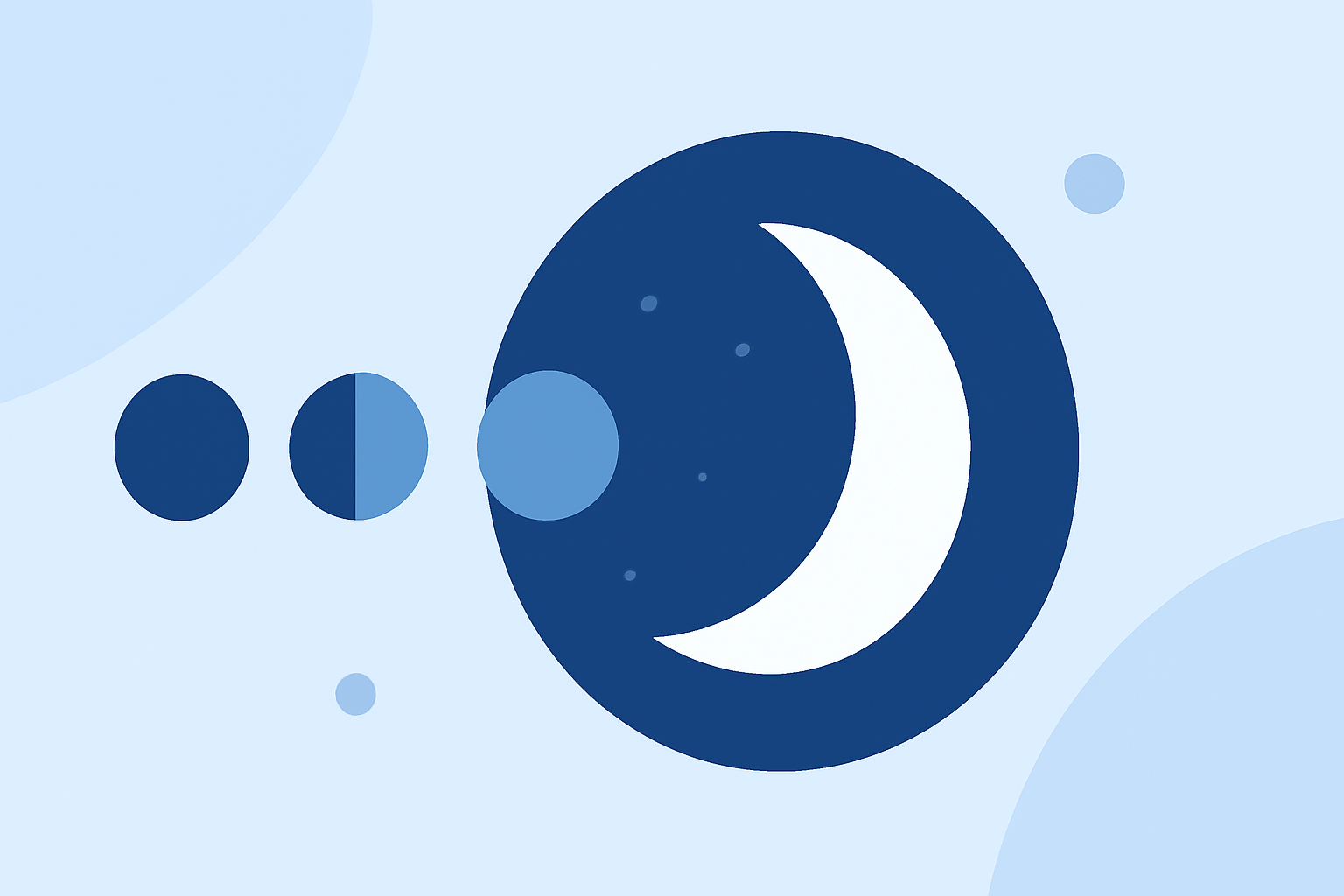
The Moon's phases are a captivating aspect of our night sky, reflecting the interplay between the Moon's orbit around Earth and the Sun's illumination. This cycle, known as the lunar cycle, spans approximately 29.5 days and consists of eight distinct phases.
What Are the Eight Phases of the Moon?
The lunar cycle progresses through the following phases:
-
New Moon: The Moon is positioned between Earth and the Sun, with its illuminated side facing away from Earth, rendering it invisible from our perspective.
-
Waxing Crescent: A sliver of the Moon becomes visible as it moves eastward from the Sun, with the illuminated portion increasing each night.
-
First Quarter: Half of the Moon's face is illuminated, appearing as a half-circle. This phase occurs when the Moon is at a right angle to the Sun relative to Earth.
-
Waxing Gibbous: More than half of the Moon is illuminated, leading up to the full Moon. The term "waxing" indicates that the illuminated portion is increasing.
-
Full Moon: The entire face of the Moon is illuminated, opposite Earth from the Sun, providing maximum brightness.
-
Waning Gibbous: The illuminated portion begins to decrease, but more than half remains visible. "Waning" signifies the reduction in illumination.
-
Last Quarter: Similar to the First Quarter, half of the Moon is illuminated, but the opposite side is lit compared to the earlier phase.
-
Waning Crescent: Only a small sliver of the Moon is illuminated before it transitions back to the New Moon phase.
Why Do Moon Phases Occur?
The Moon does not emit its own light; instead, it reflects sunlight. As the Moon orbits Earth, the angle between the Sun, Moon, and Earth changes, altering the portion of the Moon's surface that is illuminated and visible from Earth. This changing perspective results in the various phases observed throughout the lunar cycle. (science.nasa.gov)
How Long Does the Lunar Cycle Last?
The Moon completes an orbit around Earth approximately every 27.3 days. However, due to Earth's simultaneous movement around the Sun, it takes about 29.5 days for the Moon to return to the same phase, such as from one New Moon to the next. (spaceplace.nasa.gov)
How Do Moon Phases Affect Tides?
The gravitational pull of the Moon on Earth causes tides. During the New and Full Moon phases, when the Sun, Moon, and Earth are aligned, the combined gravitational forces result in higher high tides and lower low tides, known as spring tides. Conversely, during the First and Last Quarter phases, when the Sun and Moon are at right angles relative to Earth, the gravitational forces partially cancel out, leading to lower high tides and higher low tides, known as neap tides. (kopernik.org)
How Can I Observe the Moon's Phases?
Observing the Moon's phases is straightforward and requires no special equipment. Simply look up at the night sky and note the shape and illumination of the Moon each night. Over the course of the lunar cycle, you'll witness the gradual transition from New Moon to Full Moon and back. For more detailed observations, consider using a telescope or binoculars to explore lunar features such as craters and maria.
Understanding the Moon's phases not only enhances our appreciation of the night sky but also connects us to the natural rhythms that have influenced human culture and science for millennia.
Highlights:
- Moon Phases - NASA Science, Published on Wednesday, February 11
- What Are the Moon’s Phases? | NASA Space Place – NASA Science for Kids, Published on Sunday, June 11