
Understanding Moon Phases: A Simple Guide
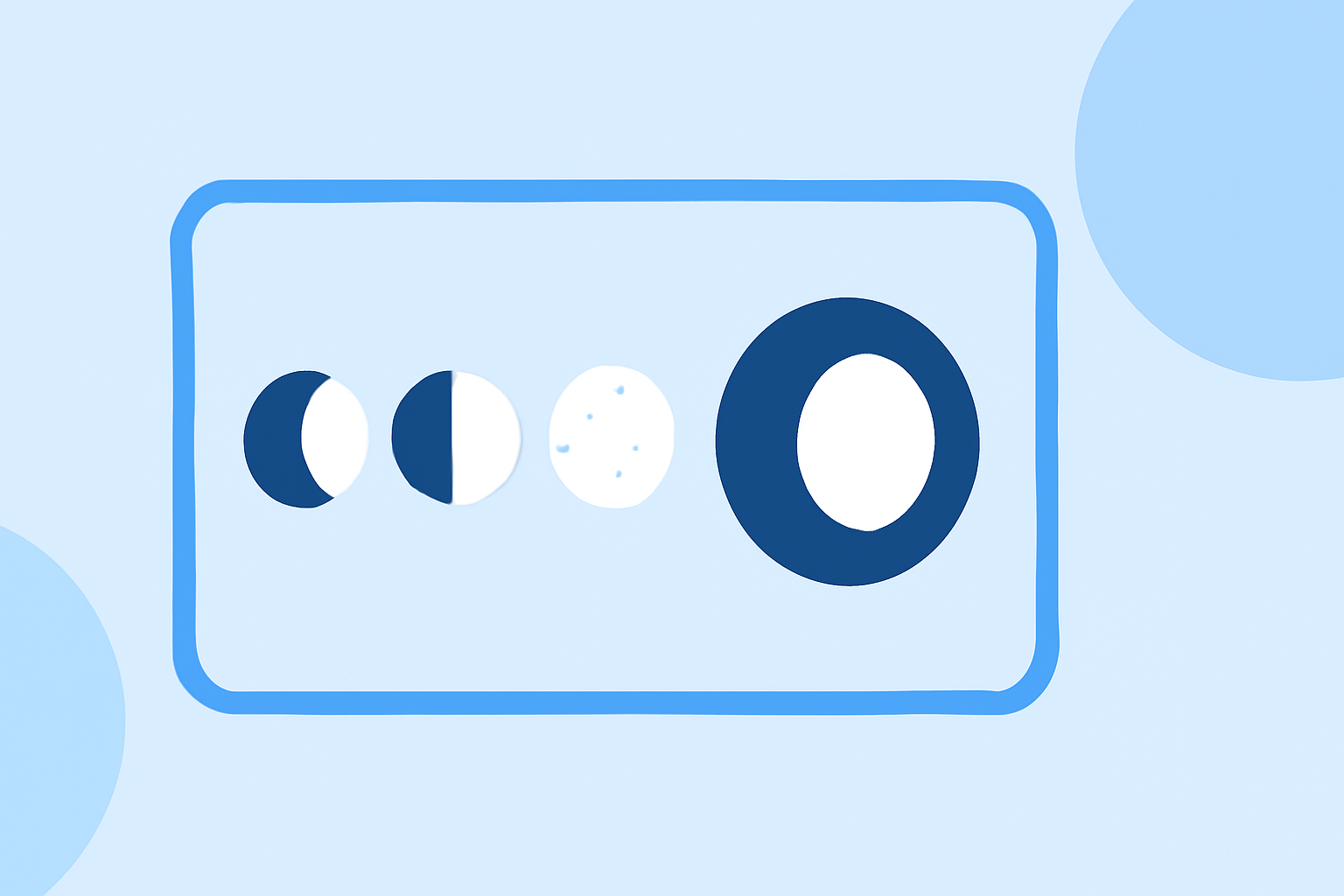
The Moon's changing appearance throughout the month is a fascinating phenomenon known as its phases. This cycle has intrigued humanity for centuries, influencing calendars, tides, and cultural events.
What Are Moon Phases?
Moon phases refer to the varying shapes of the Moon's illuminated portion as observed from Earth. These phases result from the Moon's orbit around Earth, which causes different amounts of its sunlit side to be visible from our perspective. The complete cycle of these phases takes approximately 29.5 days. (science.nasa.gov)
The Eight Phases of the Moon
The lunar cycle consists of eight distinct phases:
-
New Moon: The Moon is positioned between Earth and the Sun, making its illuminated side face away from us, rendering it invisible.
-
Waxing Crescent: A small sliver of the Moon becomes visible as it moves eastward from the Sun.
-
First Quarter: Half of the Moon's surface is illuminated, appearing as a half-circle.
-
Waxing Gibbous: More than half of the Moon is illuminated, leading up to a full Moon.
-
Full Moon: The entire face of the Moon is illuminated, opposite Earth from the Sun.
-
Waning Gibbous: The illuminated portion begins to decrease after the full Moon.
-
Last Quarter: Half of the Moon is illuminated again, but the opposite side compared to the first quarter.
-
Waning Crescent: Only a small crescent of the Moon is visible before it becomes a new Moon again.
Why Do Moon Phases Occur?
The Moon doesn't produce its own light; it reflects sunlight. As the Moon orbits Earth, the angle between the Sun, Moon, and Earth changes, altering the portion of the Moon's surface that is illuminated and visible from Earth. This changing perspective results in the various phases we observe. (spaceplace.nasa.gov)
How Do Moon Phases Affect Us?
Moon phases have a significant impact on Earth, particularly in the following areas:
-
Tides: The gravitational pull of the Moon causes ocean tides. During full and new moons, tides are more extreme, known as spring tides. (kopernik.org)
-
Cultural Events: Many cultures have festivals and traditions tied to specific moon phases, such as the Mid-Autumn Festival during the full Moon.
-
Agriculture: Farmers have historically used moon phases to determine the best times for planting and harvesting crops.
Tracking Moon Phases
Understanding the current phase of the Moon can enhance your appreciation of the night sky. Various online tools and apps provide real-time information on moon phases, helping you plan activities like stargazing or photography.
By observing the Moon's phases, we gain insight into the dynamic relationship between Earth and its celestial companion, enriching our connection to the cosmos.