
Understanding Moon Phases: A Comprehensive Guide
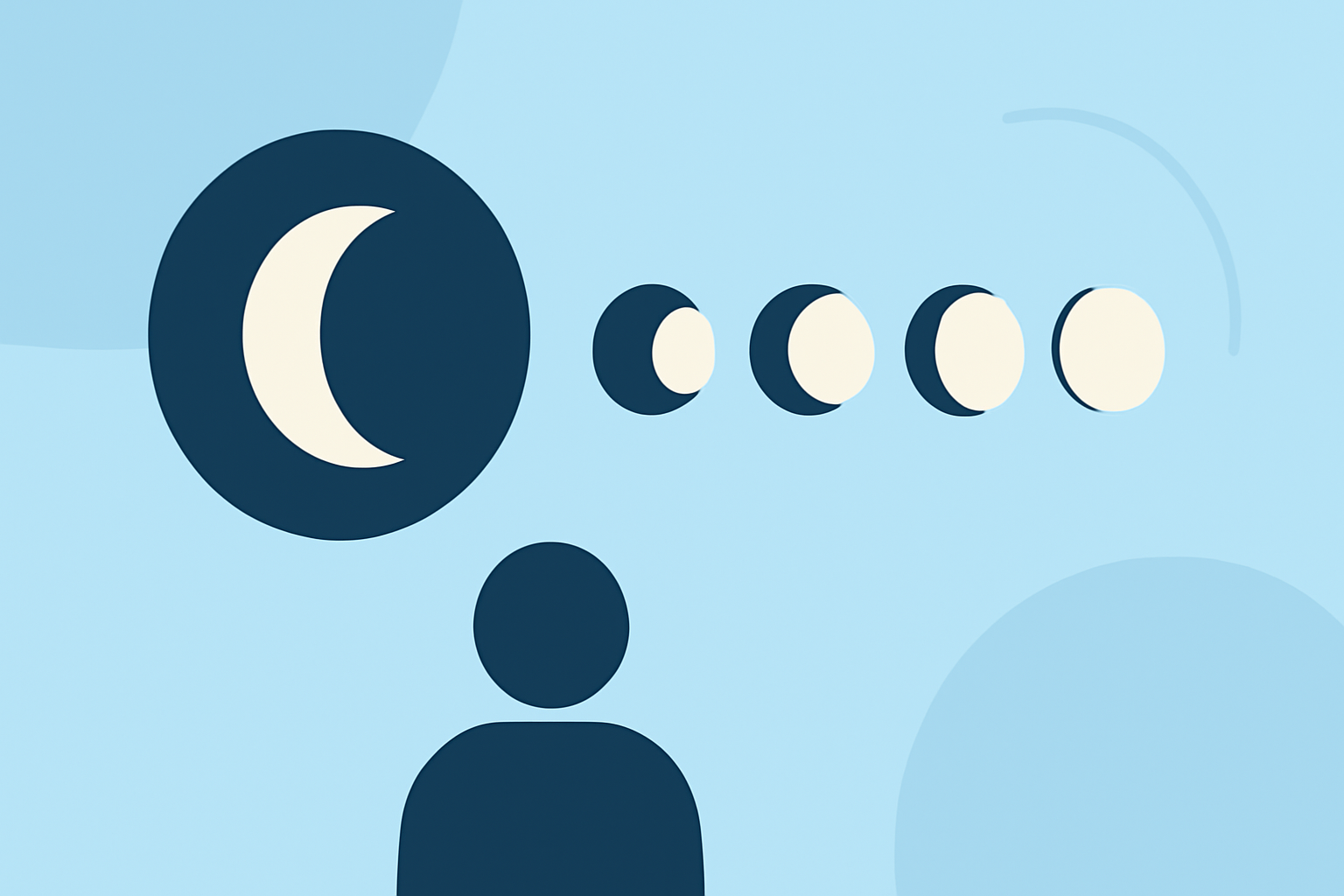
The Moon's phases have captivated humanity for millennia, influencing calendars, tides, and cultural events. Understanding these phases not only enriches our appreciation of the night sky but also provides insight into the mechanics of our solar system.
What Are Moon Phases?
Moon phases refer to the varying appearances of the Moon as observed from Earth, resulting from the changing angles between the Earth, Moon, and Sun. As the Moon orbits Earth, different portions of its sunlit side become visible, creating a cycle of phases. This cycle repeats approximately every 29.5 days, known as a lunar month. (science.nasa.gov)
The Eight Phases of the Moon
The lunar cycle comprises eight distinct phases:
-
New Moon: The Moon is positioned between Earth and the Sun, with its illuminated side facing away from Earth, rendering it invisible to observers.
-
Waxing Crescent: A sliver of the Moon becomes visible as it moves eastward from the Sun.
-
First Quarter: Half of the Moon's surface is illuminated, appearing as a half-circle.
-
Waxing Gibbous: More than half of the Moon is illuminated, approaching fullness.
-
Full Moon: The entire face of the Moon is illuminated, opposite Earth from the Sun.
-
Waning Gibbous: The illuminated portion begins to decrease after the full Moon.
-
Last Quarter: Half of the Moon's surface is illuminated again, but on the opposite side compared to the first quarter.
-
Waning Crescent: Only a small sliver of the Moon remains illuminated before it becomes a new Moon again.
These phases occur due to the Moon's orbit around Earth, which takes about 29.5 days. (science.nasa.gov)
Calculating Moon Phases from Scratch
To determine the current phase of the Moon, one can use the following method:
-
Determine the Number of Days Since the Last New Moon: Identify the date of the most recent new Moon and calculate the number of days that have passed since then.
-
Divide by 29.5: Divide the number of days by 29.5 to find the number of lunar cycles that have elapsed.
-
Calculate the Remainder: The remainder represents the current phase in the lunar cycle.
For example, if 15 days have passed since the last new Moon:
-
15 ÷ 29.5 ≈ 0.51
-
0.51 × 8 ≈ 4.08
Since 4.08 is closest to 4, the current phase is the first quarter.
This method provides a general estimate. For precise calculations, especially for specific locations, specialized software or online calculators are recommended.
Tools for Accurate Moon Phase Calculations
For precise moon phase calculations, especially for specific locations, specialized software or online calculators are recommended. These tools consider factors such as the observer's geographic location and the exact time of the lunar cycle, providing accurate and location-specific information.
Why Do Moon Phases Matter?
Understanding moon phases is essential for several reasons:
-
Tidal Patterns: The gravitational pull of the Moon affects Earth's tides, with new and full moons leading to higher tides.
-
Cultural Significance: Many cultures have traditions and festivals aligned with specific moon phases.
-
Astronomical Events: Certain celestial events, like eclipses, are closely tied to the Moon's phases.
Conclusion
The Moon's phases are a fascinating aspect of our natural world, reflecting the dynamic relationship between Earth, the Moon, and the Sun. By understanding these phases and how to calculate them, we gain a deeper appreciation for the rhythms that govern our planet.
Highlights:
- What is the moon phase today? Lunar phases 2026, Published on Monday, June 15