
Understanding the Moon's Phases: A Simple Guide
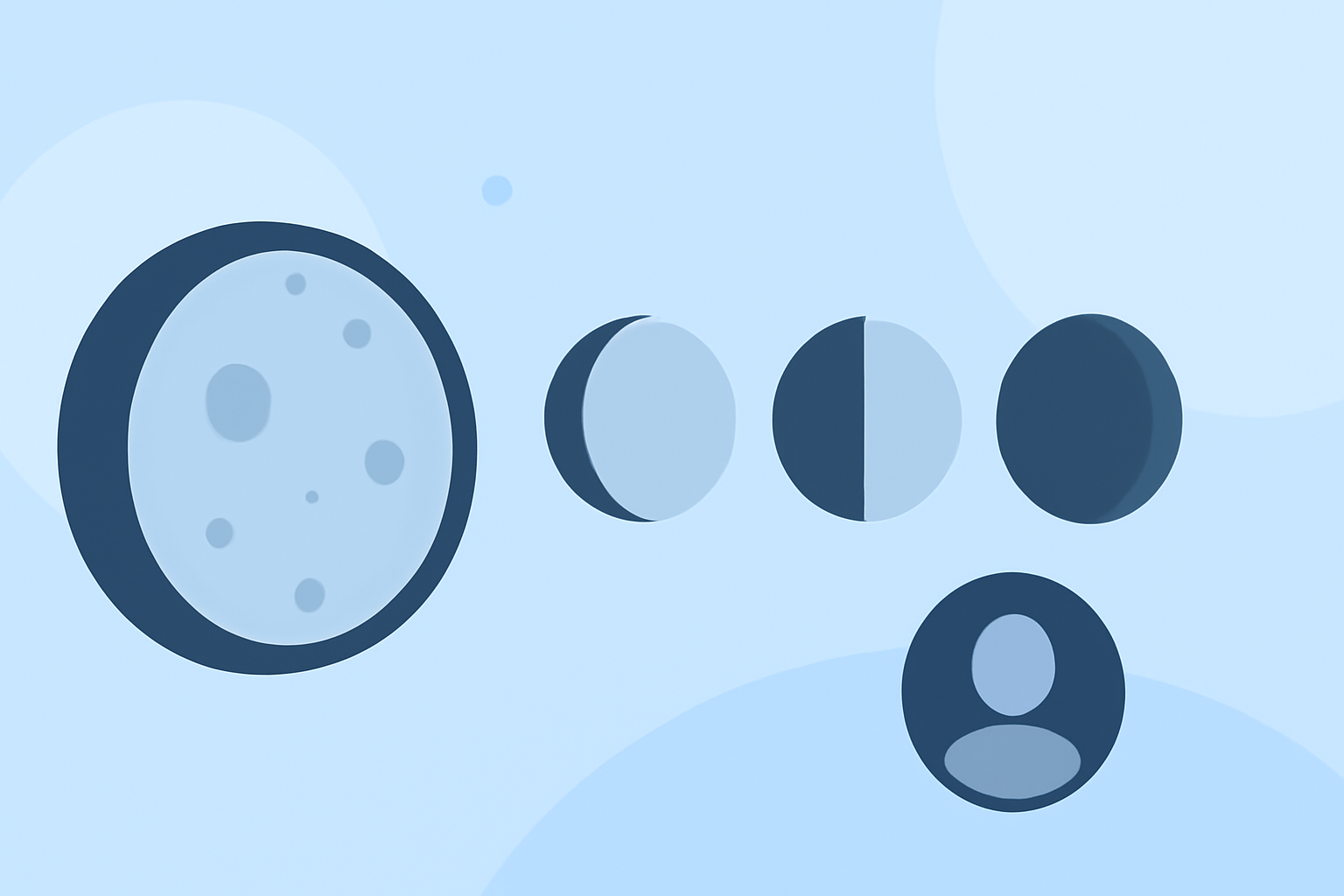
The Moon's phases are a captivating aspect of our night sky, offering a rhythmic display that has intrigued humanity for centuries. Understanding these phases can enhance your appreciation of the lunar cycle and its impact on Earth.
What Are the Moon's Phases?
The Moon undergoes a continuous cycle of phases, transitioning through eight distinct stages approximately every 29.5 days. This cycle is a result of the Moon's orbit around Earth and the varying angles at which sunlight illuminates its surface. (science.nasa.gov)
The Eight Phases of the Moon
- New Moon: The Moon is positioned between Earth and the Sun, making it invisible from our perspective.
- Waxing Crescent: A small, crescent-shaped sliver of the Moon becomes visible as it moves eastward from the Sun.
- First Quarter: Half of the Moon's surface is illuminated, appearing as a half-circle.
- Waxing Gibbous: More than half of the Moon is illuminated, approaching full illumination.
- Full Moon: The entire face of the Moon is fully illuminated, opposite the Sun.
- Waning Gibbous: The illuminated portion begins to decrease, but more than half remains lit.
- Last Quarter: Similar to the First Quarter, but the opposite half is illuminated.
- Waning Crescent: Only a small crescent of light is visible before the cycle repeats.
Why Do These Phases Occur?
The Moon doesn't produce its own light; instead, it reflects sunlight. As it orbits Earth, the angle between the Sun, Moon, and Earth changes, altering the portion of the Moon's surface that is illuminated and visible from Earth. (spaceplace.nasa.gov)
How Do Moon Phases Affect Us?
Beyond their visual appeal, the Moon's phases have practical implications:
-
Tides: The gravitational pull between the Earth and the Moon causes ocean tides. During full and new moons, tides are more extreme due to the alignment of the Sun, Earth, and Moon. (nationalgeographic.com)
-
Cultural Significance: Many cultures have developed calendars, festivals, and traditions based on the lunar cycle.
Observing the Moon's Phases
Tracking the Moon's phases can be both educational and enjoyable. Various tools and apps are available to help you monitor the lunar cycle and plan observations.
Understanding the Moon's phases not only enriches our knowledge of celestial mechanics but also connects us to the natural rhythms that have influenced human culture and the environment for millennia.